Friday, January 27, 2012

Glass Ceiling Markets Revealed

Bull & Bear with gunsFollowing up on our most recent post “Glass Ceiling Bullish or Bearish,” today, we unveil the two markets illustrated in that feature.

Below, we display the two phantom price charts presented for side-by-side comparison. We had mentioned that both were popular indices, and hinted that we had rendered one of the charts with monthly closes and the other using a chart of daily closes.

We consider one of these a potential analog to present conditions.

Analog   an’a’log (noun) U.S CHEMISTRY   A chemical with a similar structure to another but differing slightly in composition.

Though fascinating to discover, ponder, and observe, all analogs inevitably blow-up. Despite this truth, analog comparisons can be useful in observing how past price patterns resolved.

One can also compare what conditional similarities and foundational differences exist relative to the analog chart of the past and the doppelganger price pattern of the present.

 Glass-Ceiling-4_thumb2
Glass-Ceiling-3_thumb6Analog an’a’log (noun)
U.S CHEMISTRY
A chemical with a similar structure to another but differing slightly in composition.


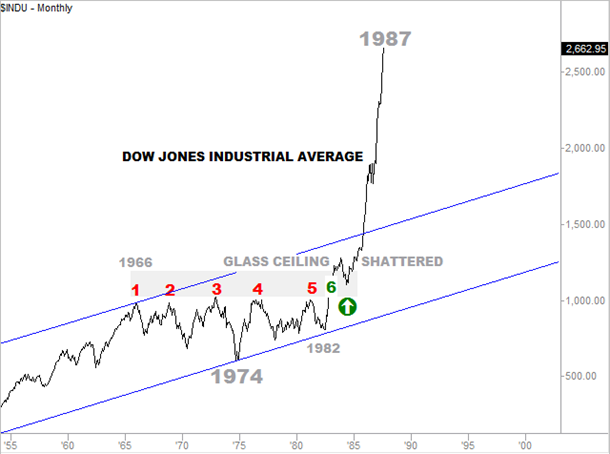
Above, the chart on the left renders monthly closes of the Dow Jones Industrial Average. The Dow’s first encounter with its “glass ceiling” occurred in 1966, while its sixth such encounter took place at the tail end of 1982.

The chart below illustrates how the Dow resolved this pattern, not once looking back in the five years after it had finally shattered its glass ceiling on the sixth try in November of 1982.
Dow 66-82 Analog Outcome 

Above, the small chart on the right renders daily closes of our modern-day doppelganger, the NASDAQ 100. The NASDAQ 100’s first encounter with its “glass ceiling” occurred on February 16, 2011, while its fifth and recent encounter took place on January 18, 2012.

The chart below illustrates the NASDAQ 100 currently amid its fifth attempt within the last twelve months at breaking out above, and shattering its overhead glass ceiling.

If the NASDAQ-100 is to produce an outcome with any semblance to the analog depicted in the 1966 – 1982 Dow, the prospective wave count, amplitude, and degrees of trend noted below, will jettison the NDX toward the 3300 level in no time flat.


Comparison NDX-2012


Perhaps, insofar as its 83.4% two-year wipeout in 2002, which clearly broke its degree of trend correlations with the Dow, the NASDAQ may be about to embark upon another disconnect of sorts, one that may seek to realign its broken trend correlation with the Dow and S&P.

After all, another mini tech-boom that rockets the NDX away from the pack toward 3000, will merely amount to a common 61.8% retracement of its previous two-year wipeout in 2002, which we consider as the base terminal of Cycle Degree “A”.

Here are a few interesting facts about the NASDAQ disconnect during its unrelenting bubble-spike into 1999, its total destruction in 2002, and its stunning full recovery last year from the 2008 bear market lows.  

  • In the bear market of 2002, the NASDAQ was completely wiped out (-83.4%) while the Dow lost only 38% of its value.
  • In 2007, the Dow reached a new historic all-time-high while the NASDAQ struggled with a paltry 38.2% retracement of its complete annihilation in 2002.
  • In 2008-09, the NDX held above its 2002 lows, while both the Dow and S&P breached well below their respective 2002 lows.
  • In 2011, the NDX retraced 100% of its 2008-09 declines, and trades higher today than at its peak in 2007.  The same cannot be said for the Dow or the S&P 500.

Comparing Analogous Fundamental Conditions

So what was foundationally similar in the period spanning 1966 – 1983 for the Dow relative to the (twenty-times-condensed) doppelganger illustrated in the NASDAQ 100 in 2011?

For one thing, in the late 70’s and early 80’s, the world was enmeshed in a situation that is somewhat analogous to the conditions it faces today.

  • Tension in the Middle East
  • High Energy Prices
  • High Gold Prices
  • Runaway Inflation
  • Rising Interest Rates

Looking at the list above, it appears that we are only missing two crucial ingredients, runaway inflation, and rising interest rates.

Institutions like the Fed, ECB, World Bank, or the IMF, who are in positions of influence over these things; fancy themselves as having the necessary control over all aspects of what they are doing to address the world’s current problems; are they correct in their assumptions or are they wrong.

One can argue that global and financial challenges occurring between 1966 and 1982 were just as dire if not more so than they are at present. 

Yet somehow, perhaps with the assistance of Nixon moving the world completely off any remnant of the Gold Standard, we managed to unleash a powerful and sustained inflation, which provided the miracle-elixir that enabled economies to breakthrough their seemingly insurmountable challenges.

Closing Thoughts

Will events unfold differently this time? Though the past and present may rhyme to some extent, in our view, one must consider two profound foundational differences.  

The first is that the hyper-inflationary effects unleashed by Nixon in 1971 removing the last remaining anchor to Gold, (which provided some level of efficient free-market moderating effects on global trade) has expended its entire payload.

The second, is that the flawed and distorted application of a centrally planned Keynesian approach to managing global economies void of tangible anchors or restraints, has created unfathomable levels of debt from which there is no escape and no turning back.

The most likely reason that we are lacking runaway inflation and rising interest rates is due to global banking cartels going “all-in” and fighting the free-market with their perpetually flawed interventionist policies in attempt to once again avert, delay, or subdue the markets natural deflationary forces of unwinding and cleansing itself of excessive malinvestment.

Lastly, we leave you with another puzzle to play with.  Given all that is known about flawed monetary policy and its effect on nominal values, from an Elliott Wave perspective, how would you label the S&P-500’s 2000, 2002, 2007, and 2009 market terminals relative to their respective degrees of trend.


S&P Monthly Bars

Until next time,

Trade Better / Invest Smarter

Read More ->>

Thursday, January 26, 2012

Audit the Fed

Campaign for LibertyDear Fellow American,

I ran for the U.S. Senate to end the federal government’s out-of-control spending and solve our debt crisis.

But that can't be done until we tackle the source of the problem: the unaccountable Federal Reserve.

As long as Ben Bernanke keeps printing money, the government will keep spending it.

You and I need to end that right now.

And just like during my campaign, the establishment is stacked against us. But look at what has already been accomplished with you in our corner!

Please take a few moments to read the message below from Campaign for Liberty Vice President Matt Hawes and support C4L in this vital effort to rein in the Federal Reserve.


For Liberty,
Campaign for Liberty
Senator Rand Paul


Campaign for Liberty

Dear Patriot,


Trillions of dollars have been stolen from U.S. taxpayers.

You and I, right now, are seeing the worst plundering of a country's wealth in the history of civilization, led by an out-of-control Federal Reserve.

But you and I together CAN put a stop to it all.

With your help (including completing the petition to your representative and senators) today, Campaign for Liberty is ready to take the battle straight to the heart of the problem - the Federal Reserve itself.

Last year, we came close to enacting a full Audit of the Fed.

This year, with more Fed opponents put in office and the economy still reeling, we have our best chance ever.

But you must act today.

Just think about the scope of the problem.

The massive, outrageous amount of dollars recently committed to the economic bailouts totals:

More than the socialist New Deal...

More than the entire Iraq debacle...

More than the 1980's savings and loan mess... More than the Korean War...
COMBINED.

Where will it all end?

It's time you and I put a stop to an out-of-control Federal Reserve.
And Ron Paul has a bill before Congress to do just that.


Campaign for Liberty


That's why it's vital you fill out your personal "Audit the Fed" petition in support of Congressman Paul's bill.

This bill, introduced in the House by Congressman Ron Paul and in the Senate by Senator Rand Paul, will finally pull the lid off the FED and expose its outrageous power grabs.

Now is the time to make sure your representative and senators feel the heat to support the Audit the Fed bill!

If you and I don't act today, I'm afraid this crisis will end with the economic ruin of every man, woman, and child in the United States.

Today, over 16 TRILLION in taxpayer dollars in bailouts and loans have been agreed to by Congress, the Bush and Obama Treasury Departments, and the out-of-control Fed.

So is it really any wonder more and more folks are starting to realize the Washington, D.C. establishment is hurtling us toward complete economic disaster?

Whether it's watching a phony "stimulus" package get rammed into law or seeing Congress pass a $700 BILLION bank "bailout," the American people are agitated and increasingly angry.

You saw the result of that anger in the Tea Parties last year and then in the November elections.

Statist, pro-Fed politicians were tossed out of office left and right!

That means it's a perfect time to unleash the pressure of MILLIONS of outraged Americans on the out-of-control Fed today!

So please agree to complete your petition urging your Representative and Senators to cosponsor and seek roll call votes on Audit the Fed - the first step toward ENDING THE FEDERAL RESERVE once and for all!

As I know you're aware, the Federal Reserve is shrouded in secrecy.
Its meetings are off-limits to the public.

Its inner-workings are off-limits to the public.

Fed leaders know coming clean with Congress and the American people on how they create money out of thin air would result in an anti-Fed firestorm.

So can you imagine the impact of a full-scale audit?

You and I will finally be able to show the American people that the Federal Reserve System leads to:

***  Constant economic crises - the housing crisis and the resulting chaos is just one example of an economic bubble created by centrally-planned interest rates and money manipulation;

***  The destruction of the middle class - as fuel, food, housing, medical care and education costs soar, everyone who is NOT on the government dole is forced to make do with less as the value of their money slowly decreases;

***  Currency destruction - history shows us that riots, violence, and full-scale police states can result when people finally realize fiat money isn't worth the paper it's printed on and REFUSE to accept it.

And unless you and I do end the madness in Washington, D.C., we may be closer than we'd like to think to learning that history lesson firsthand, right here on the streets of our towns and cities.
That's why your commitment to helping pass the Audit the Fed Bill - and helping Campaign for Liberty fight this battle - is so vital.


Campaign for Liberty


Just a few years ago, there was no chance of passing any legislation like Ron Paul's Audit the Fed Bill.

So I guess there has been one "CHANGE."

You see, with the piling up of trillions of dollars in out of control "bailouts" of Wall Street and international bankers, even many politicians in Washington, D.C. want to show you they're "being responsible."

What better way for Congress to do this than by auditing the Federal Reserve to account for the trillions stolen from U.S. taxpayers?

More and more Congressmen are already feeling the pressure and are signing up to support this bill.

I've even received word Audit the Fed could move in the coming weeks in the U.S. House.
When that happens, you and I must be ready to fight.

There will be many battles you and I must wage over the coming months to take back our country.

But this one is set to rage in Congress in just a few short weeks.

And, it's both a bill we CAN pass and one that is vital to exposing the massive corruption and downright evil at the Federal Reserve.

You see, after regulating, taxing, spending, borrowing, and printing us into what looks like the worst recession in decades, establishment politicians and power brokers are assuring us they're working hard to "fix" our economic woes.

What is their solution?

You guessed it.

More of the same!

I'm convinced that if you and others will insist on Congress passing Audit the Fed, the votes will be there.

Then the question is whether Barack Obama will sign it.

But here's the thing: even if the Audit the Fed bill is vetoed by Obama, just forcing him to do it is a win/win situation.

Can you imagine how it will look in the 2012 election when you and I tell the American people President Obama refused to even LOOK for the trillions of dollars stolen from the taxpayers?

Now, we just need to show Congress the American people demand action on Audit the Fed.


Campaign for Liberty


Here's how we plan to do that.

First, we're already busy contacting up to seven million activists nationwide through mail, phones, and email to generate petitions to the U.S. Congress demanding action on "Audit the Fed".

But that's just the beginning.

We'll work the talk radio stations and grant local media interviews to further turn up the pressure on Congress.

And a few days before the vote, if we have the resources, we'd also like to run hard-hitting targeted radio, TV, and newspaper ads.

This entire program is designed to send this one, CLEAR message to Congress - Any politician who votes against the Federal Reserve Audit should look for another job.

But such a massive effort won't be easy - or cheap.

So, in addition to your signed petitions, I also hope you'll agree to chip in a contribution of $10 to Campaign for Liberty.

If we don't take action, the America we see in just a few years could look far worse than even the one we see today.

Can I count on you to join the fight to AUDIT THE FED by filling out the Petition and chipping in a quick $10 contribution right now?


In Liberty,
Campaign for<br />Liberty
Matt Hawes
Vice President


P.S. Please complete your petition DEMANDING your Representative and Senators cosponsor and seek roll call votes on the Audit the Fed Bill TODAY!

With federal spending at record levels, and TRILLIONS of new dollars flying off the printing presses, it's never been more important the Federal Reserve's abuses are exposed to the American people once and for all.

So along with your signed petition, please chip in a contribution of $10, $25 or even $50, to Campaign for Liberty TODAY!

Campaign for Liberty

Read More ->>

Tuesday, January 24, 2012

Glass Ceiling Bullish or Bearish?

HS6ClipImage_4f1e58e5_thumb[1]We have all heard of the proverbial “glass ceiling” in the business world where one attains a certain level of achievement and is unable to advance any further.

Well, the same thing happens to share values from time-to-time. They reach a certain price level, and no matter how hard they try, they are simply unable to shatter the glass ceiling overhead.

Price charts clearly reflect such episodes and offer some analog-based clues as to what may manifest following these prolonged battles at overhead resistance.

We provide two such examples below. One is an analog from the distant past, and the other is playing out in real time. Both are major equity indices. Can you recognize either of these popular equity indices?

Glass Ceiling-3

Does either of these look familiar? What indices are they? Which is the old, and which is the new?

Glass Ceiling-4
The first index on top sports 6-tests at the glass ceiling of resistance, while the second index shows five attempts at breaking through the resistance barrier.

If you think you have identified either of these beauties, which is the chart of the distant past and what was its outcome? Which is the chart currently unfolding in real time?  What are the general time-periods of both the old and the new?

Well, that’s all for now. Don’t worry, we won’t’ leave you hanging for long. In the next few days, we will provide a follow up piece with all of the answers along with some forward-looking analysis as well.

Do reply with a post or send us an email with your best guesses.

What do you say we make things a bit more interesting?

How about:

  • The first thirteen non-subscribers (all of our current subscribers already know the answers) who get the two markets correct will get a complimentary issue of our Near Term Outlook.
  • The first eight (non-subscribers) who get the two markets and analog outcome correct will get a complimentary issue of EWT’s Charting Bundle.
  • Finally, the first five (non-subscribers) to also provide the general time-periods for each of the charts, will get a complimentary issue of the Chart-Cast Pilot.
We will give you one last hint. One of the indices is a chart of daily closing prices, while we have rendered the other using a chart of monthly closes.

Now post/mail in your answers and we will report all winners with the follow-up feature and analysis by the weekend.

Until then,

Trade Better/Invest Smarter

Joe Russo
Publisher and Chief Market Analyst

Elliott Wave Technology

Read More ->>

Monday, January 23, 2012

Lifetime Pilot Performance: 1081.06%

S&P 500 Long-Term Investment Equity CurveHere we provide the big-picture, long-term performance stats for the Chart-Cast Pilot portfolios.  Our spreadsheet breaks down returns by market, account-type, and trading/investment strategy.

Long-term investment account statistics go back as far as 1973, while Mid-Level and Short-Term trading stats reflect performance from 2007 to date.

This historical account provides testament to the efficacy, benefits, and rewards, that accompany adherence to proven trading and…

…investment strategies, which have delivered robust returns over various market cycles. 

Incorporating three distinct accounts for each market/stock traded provides for a level of strategic diversification that is virtually immune to periods of high correlation such as we have experienced over the past several years.

We have broken down each broad market and individual stock held within our portfolios by engagement at three distinct timeframes, and we have listed each under the “Account Type” column.

The year in parenthesis following LT (long-term) Investment Accounts denotes the year in which our strategy engaged that market or stock.

HS6ClipImage_4f1ce524

For long-term engagement in the broad market equity indices, under the “#Contracts/Shares” column, we represent an initial 10K exposure to these indices as the indices themselves are not actual tradables. 

For long-term engagement in Gold, Crude Oil, and the Long Bond, we recorded performance basis a single continuous futures contract.

Mid-Level and Short-Term trading accounts contain the symbol for the actual tradable under the #Contracts/Shares column.

The “Profit-Factor” column is a TradeStation generated measure of profitability. The Profit-Factor reflects the amount made relative to the amount lost. By definition, a value greater than one means that the total number of trades recorded contain a positive net profit. The higher the profit factor the greater the level of profitability.

Generally, long-term investment accounts will trade much less frequently. Mid-Level trading accounts focus engagement on the intermediate term timeframe and as a result, they typically generate a greater number of trades vs. longer-term core investment positions. Short-term trading accounts focus engagement on the short and near term. These accounts generate the greatest number of trades.

The “%Profitable” column displays the percentage of trades that were profitable amongst those recorded for each strategy. Note that high win rates are not typical for robust strategies that perform well over various market cycles. Robust profits are quite common amid strategies that sport win rates of 30% and less.

Read More ->>

Sunday, January 22, 2012

2011 Pilot Performance: 20.73%

HS6ClipImage_4f1c2cb5 No doubt 2011 was a challenging year for traders and investors. The Dow Jones industrials finished the year sporting a 5.5% gain. The NASDAQ Composite Index closed down about 1.8%. And, amazingly, the Standard & Poor's 500 Index ended almost exactly flat.

To be precise, the change was four one-hundredths of a point: 1,257.60 compared with 1,257.64 in 2010. The percentage change was 0.0032% and is nearly the index's smallest change -- positively or negatively -- ever.

That the changes for the major averages would be so small may be hard to believe in a year that saw the major averages rise more than 8% by April 29 and then fall 17% or more from those levels by early October. Below is a list of broad asset returns for 2011.

HS6ClipImage_4f1c2e37

Combined, the 20 asset classes benchmarked above returned a total loss of (–2.72%) for 2011. In contrast, our broad market portfolio (shown below) had a positive 2011 return of 3.12%, while our individual stock portfolio returned 38.34% for a combined average total return of 20.73%.

PORTFOLIO RETURNS: CHART-CAST PILOT

HS6ClipImage_4f1c92e7

Read More ->>